Case Study 02 · SunLife Financial
When the claim was real but the system made it feel impossible
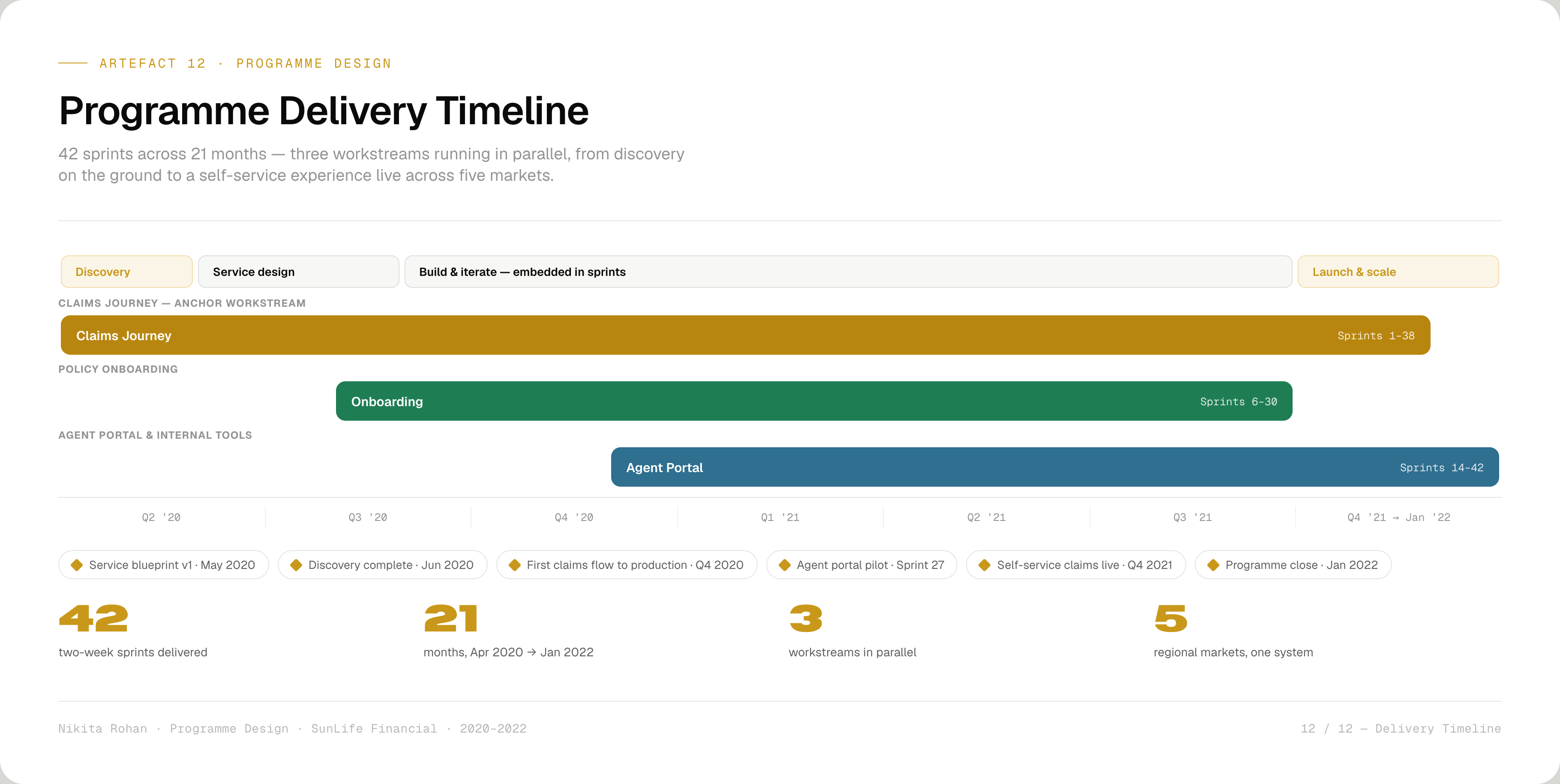
18 months. Three workstreams. Five markets: Hong Kong, Vietnam, Malaysia, Indonesia, the Philippines. Taking SunLife Financial from agent-dependent paper processes toward standardised self-service, including mySunLife activation, where every policyholder had an account and almost none could get into it.
- Role
- Product & Service Designer
- Timeline
- Apr 2020 – Jan 2022
- Scope
- Claims · Onboarding & Activation · Agent Portal
- Markets
- Hong Kong · Vietnam · Malaysia · Indonesia · Philippines
- Embedded with
- Legal · Compliance · Eng · Ops
01 · Context
A 100-year-old insurer facing a digital ultimatum
SunLife Financial is one of the largest insurance groups in Asia, with deep roots in Hong Kong and a regional footprint across multiple markets. Decades of customer relationships were built on branch networks and agents. That model worked, until it didn't.
By 2020, COVID-19, rising customer expectations and aggressive competition from insurtech players made the status quo unsustainable. Customers couldn't file a claim, set up a policy, or access their account without physically involving an agent.
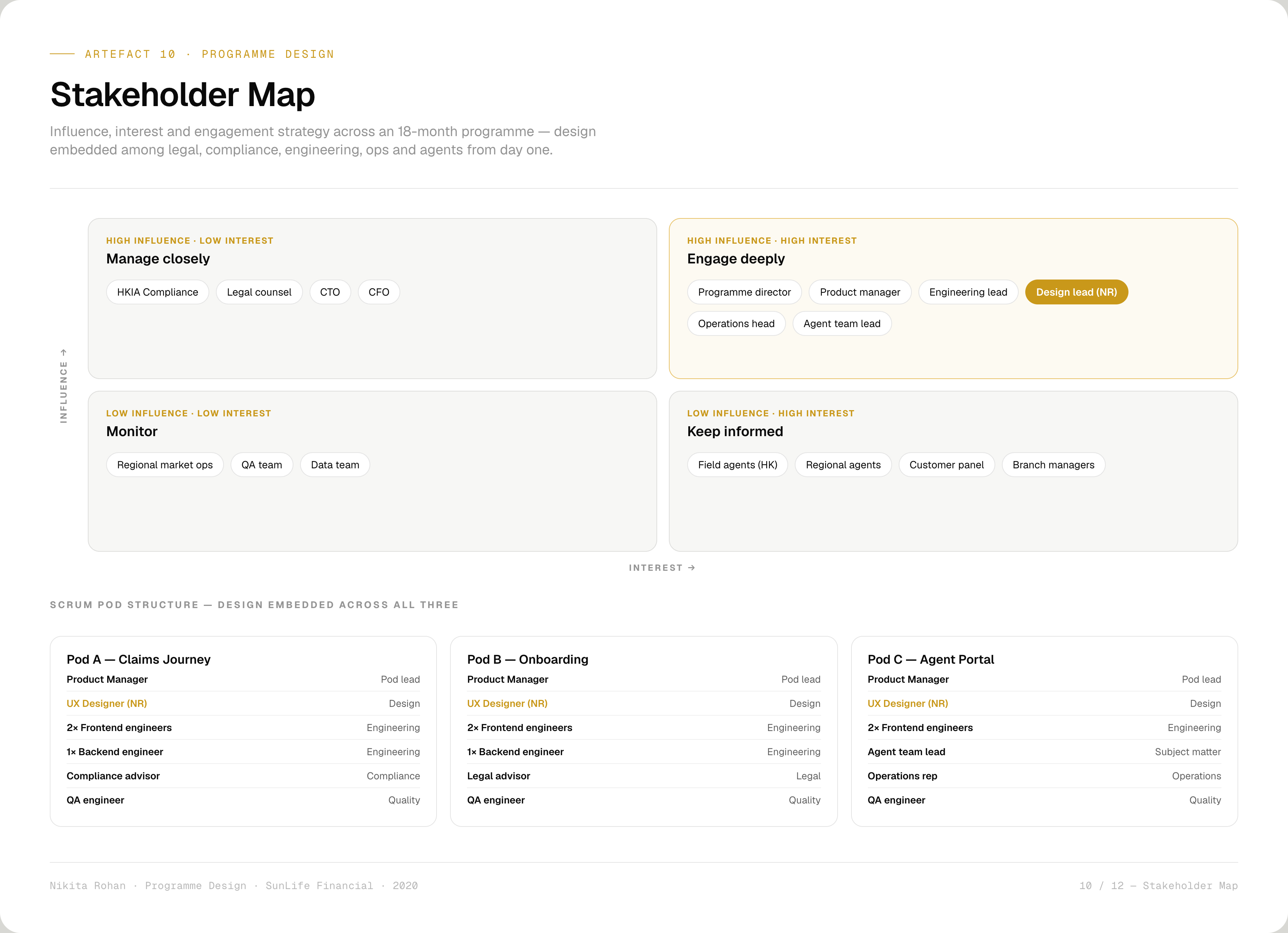
I joined as a product and service designer embedded in cross-functional scrum teams, working directly alongside engineers, compliance, legal and operations from discovery through to live production. The core challenge: design one system that could be standardised across five regional markets, each with different regulations, languages and levels of digital maturity, without fragmenting into market-specific builds.
02 · The Problem
Every customer interaction required a human in the middle
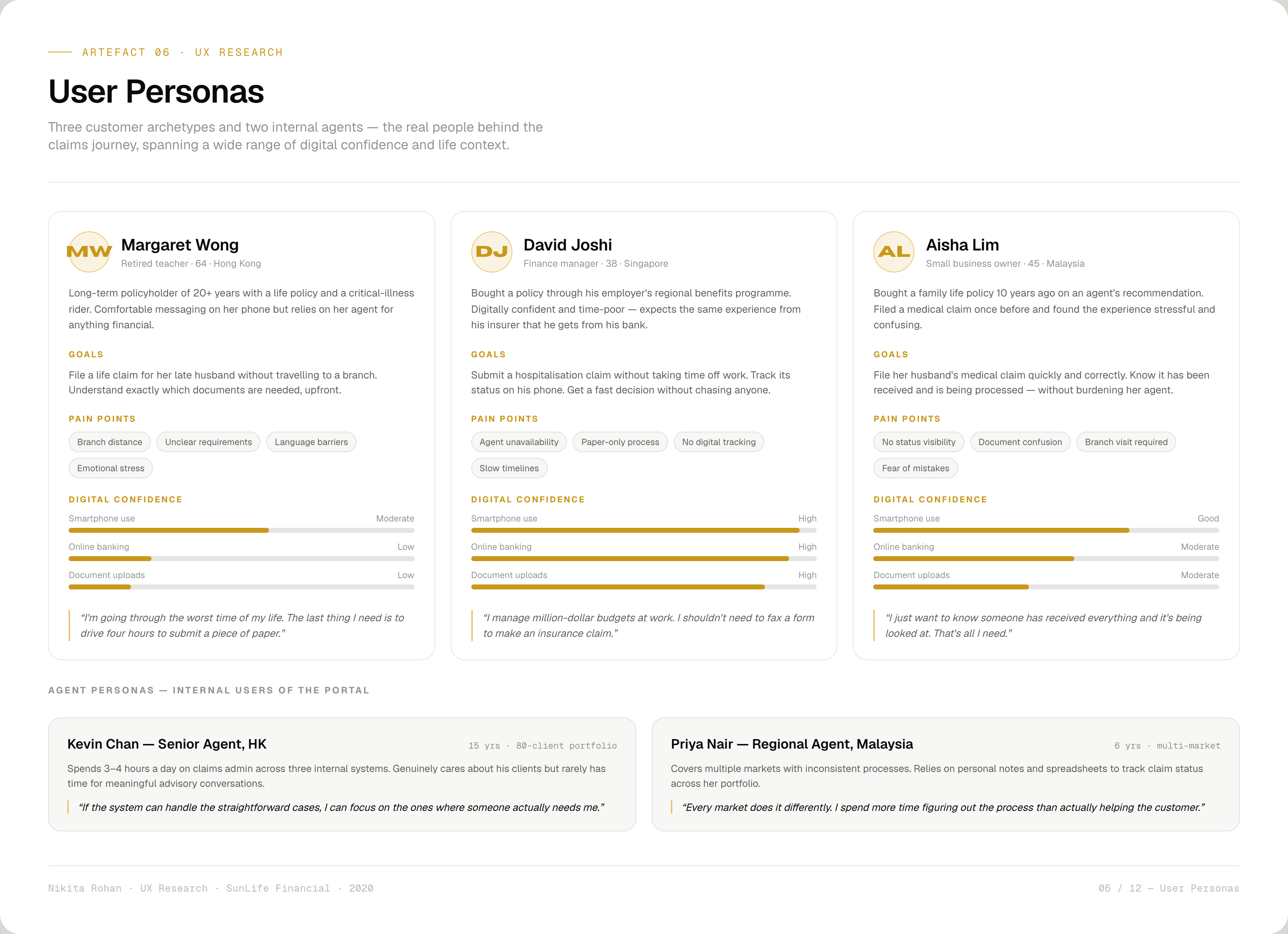
Before the transformation, a customer with a legitimate claim (medical, life or critical illness) had to contact their agent, who provided paper forms, collected documentation, submitted on their behalf, then chased the back-office for approval. The customer had no visibility, no agency, no timeline.
The complaints data was unambiguous. The most common categories weren't about policy terms or claim decisions. They were about process opacity, wait times, and the inability to track status. Customers weren't unhappy with SunLife's products. They were exhausted by its processes.
Before: the agent-dependent reality
- No self-service claims: every claim required an agent
- Paper forms collected by hand or fax, then manually keyed in
- No real-time status tracking: customers called to check
- KYC and identity verification done in branch
- Medical documentation submitted as physical copies
- Agent portal fragmented across disconnected systems
- No digital audit trail: email chains and paper files
After: the self-service digital experience
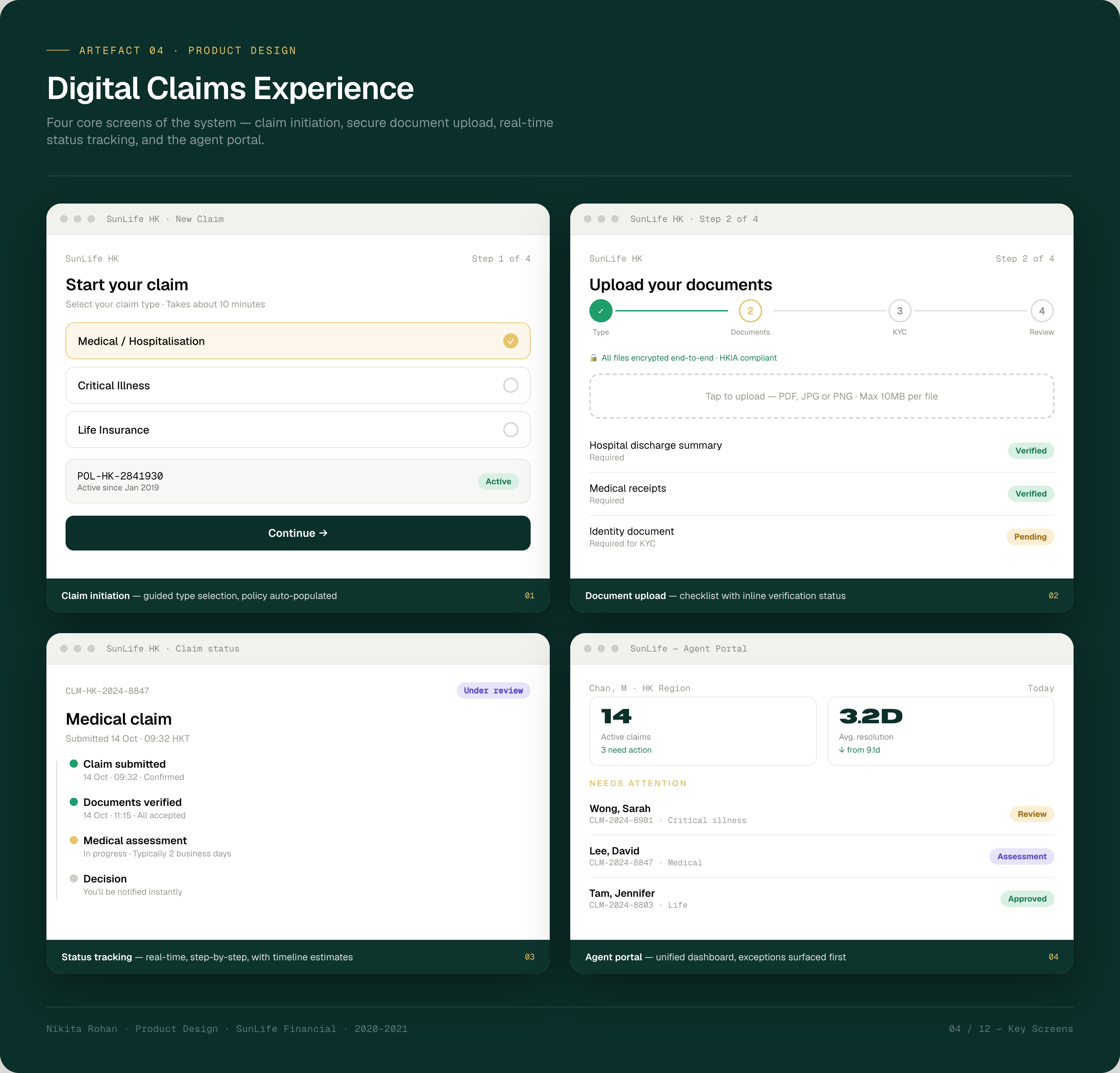
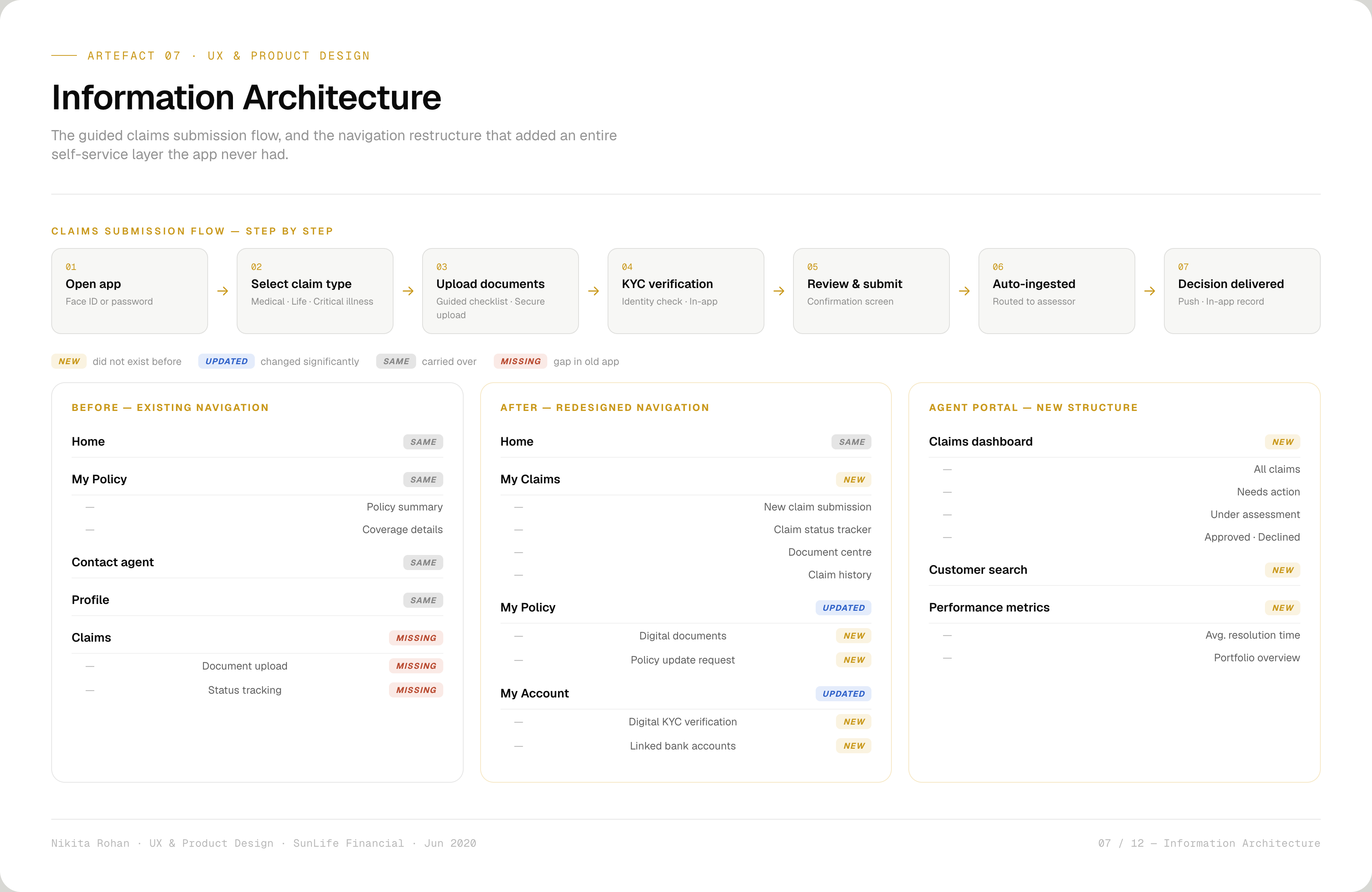
- End-to-end digital claims, customer-initiated and agent-optional
- Secure upload: KYC, medical docs and payment, all digital
- Real-time status tracking with push notifications
- Digital identity verification, no branch visit required
- Policy onboarding completed remotely from any device
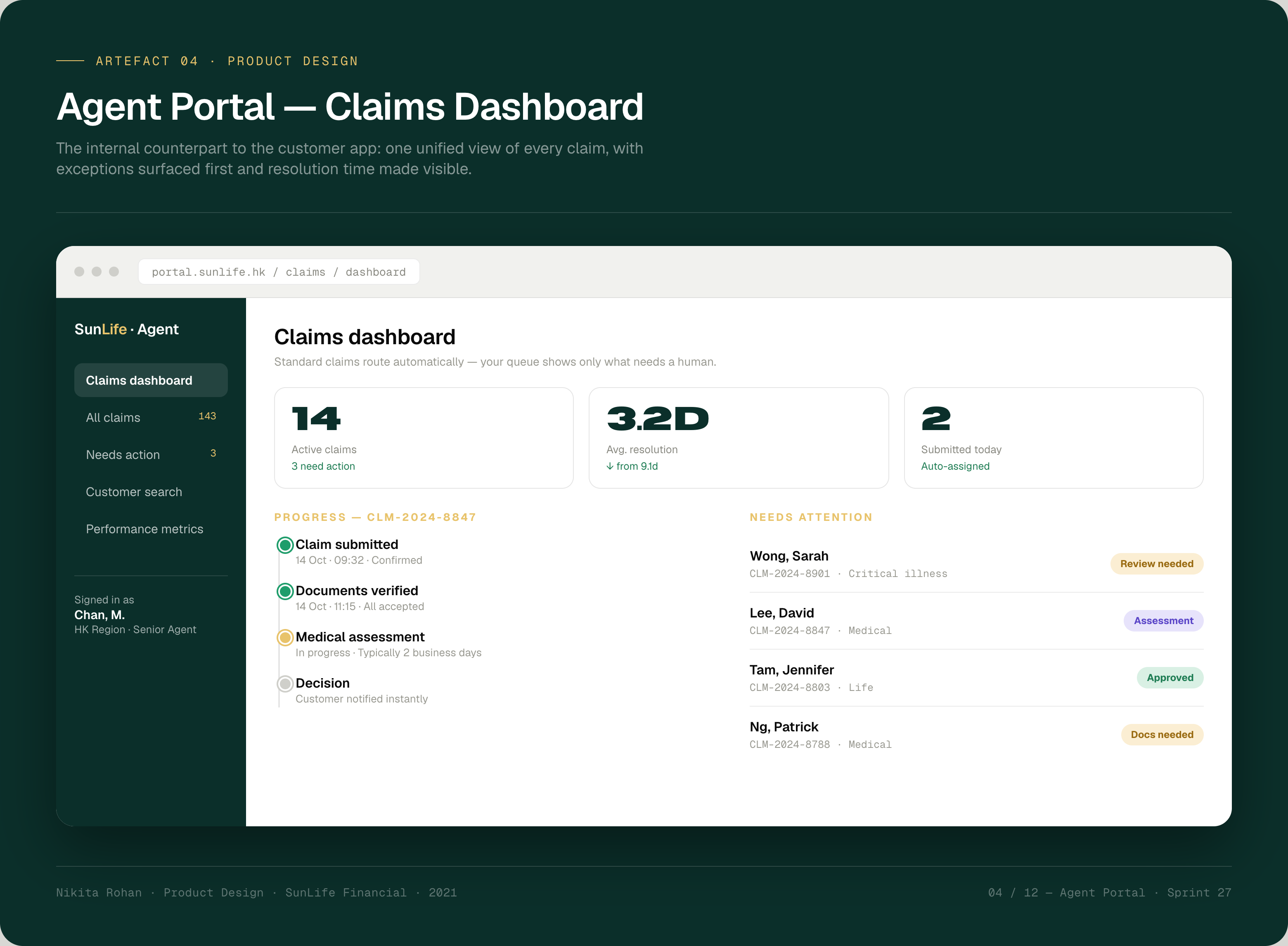
- One unified agent portal replacing fragmented tools
- Full digital audit trail across every interaction
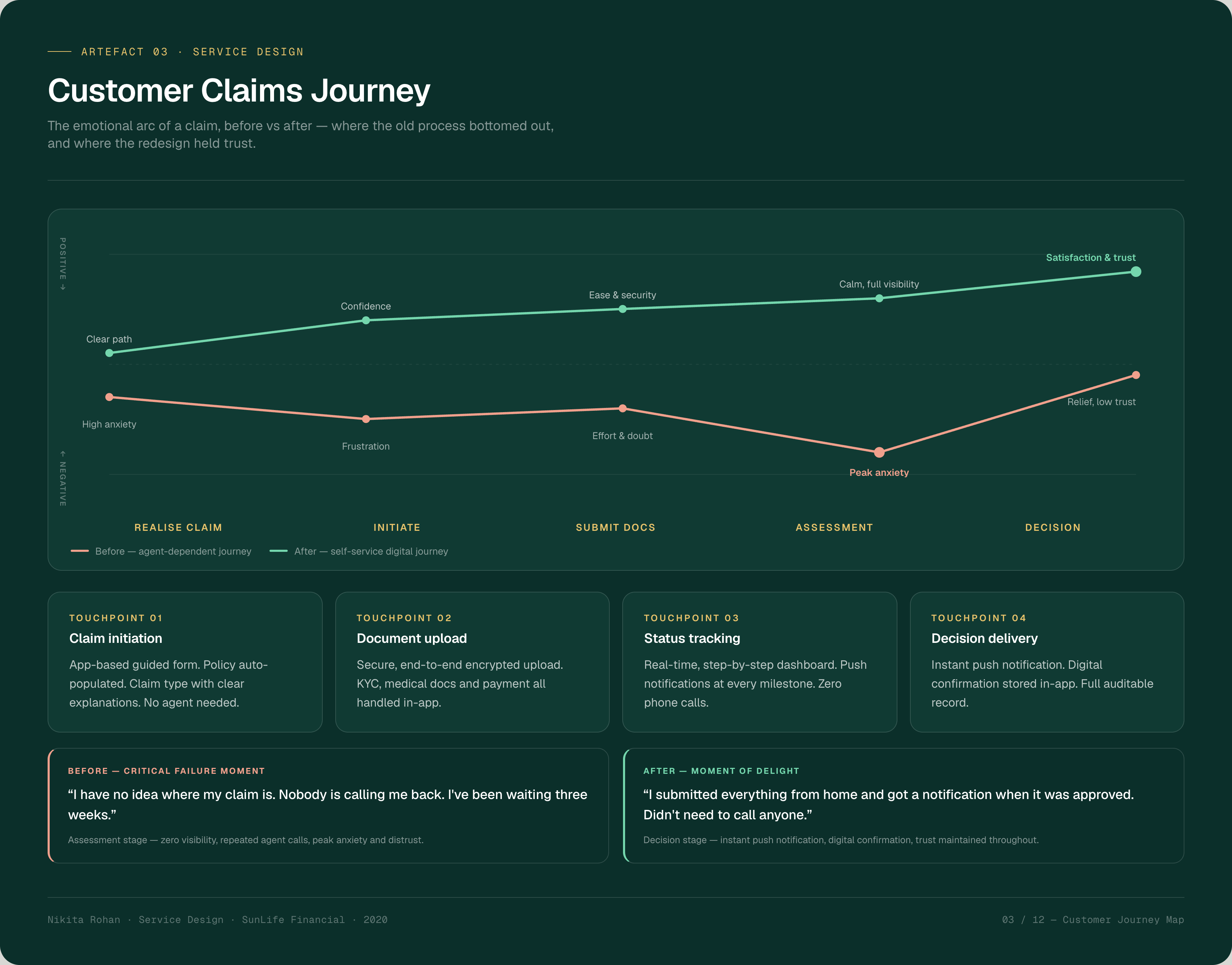
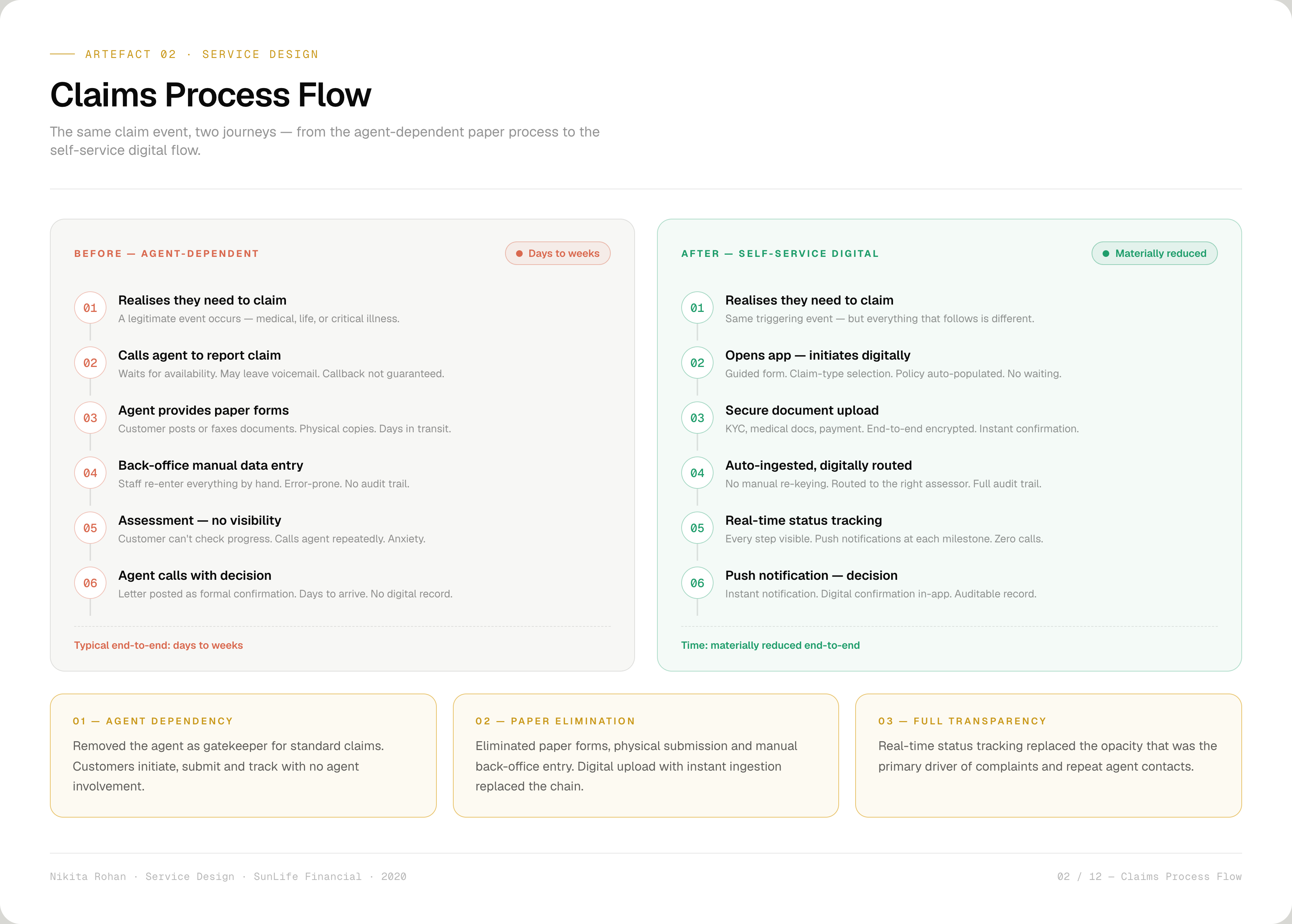
“The problem wasn't that agents were doing a bad job. It was that agents were doing jobs a digital system should have been doing, and nobody had time left for the work only a human can do.”
03 · Scope
Three workstreams. One transformation.
The programme ran as three parallel workstreams, each with its own scrum pod, stakeholders and complexity. Claims was the anchor and the most customer-visible. Onboarding and the agent portal ran alongside, feeding the shared design system as it matured.
Claims Journey: the anchor
The most customer-visible and highest-priority piece. The end-to-end digital claims experience, from first notification through documents, KYC, medical evidence and payment, for health, life and critical-illness products across HK and regional markets.
Onboarding & mySunLife Activation
Two related problems. The easier one: a fully remote, digitally-verified path for new policies. The harder one: getting existing policyholders to activate the mySunLife account every one of them already had. Almost none had.
Agent Portal & Internal Tools
The fragmented agent systems unified into one portal: full visibility of customer accounts, claims in progress and action items. Critical for adoption: if agents didn't trust it, customers wouldn't benefit.
04 · What Made This Hard
Insurance is a different kind of design problem
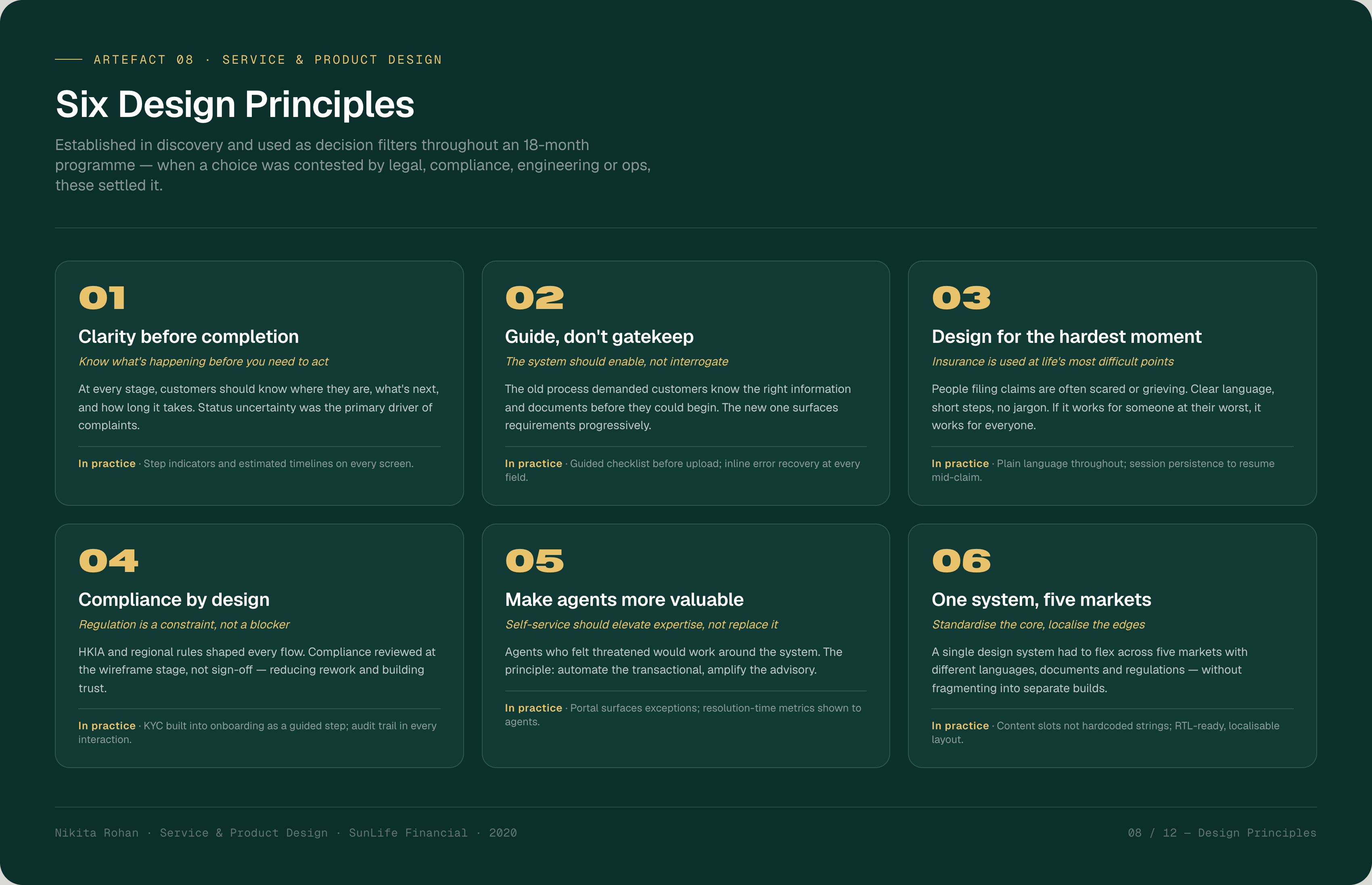
Designing for a regulated financial-services organisation across multiple Asian markets is not designing for speed and conversion. Every decision had to navigate regulatory constraints, legal requirements, compliance obligations and deeply entrenched operational processes.
Regulatory compliance
Every flow had to satisfy HKIA regulations and regional equivalents. Legal reviewed every screen. Compliance signed off every copy string. Simple-looking decisions often carried three-week approval cycles.
Document security & KYC
Handling medical records, identity documents and payment details digitally required end-to-end encryption, audit trails and secure upload flows that satisfied both the regulator and the customer's trust threshold.
Multi-market localisation
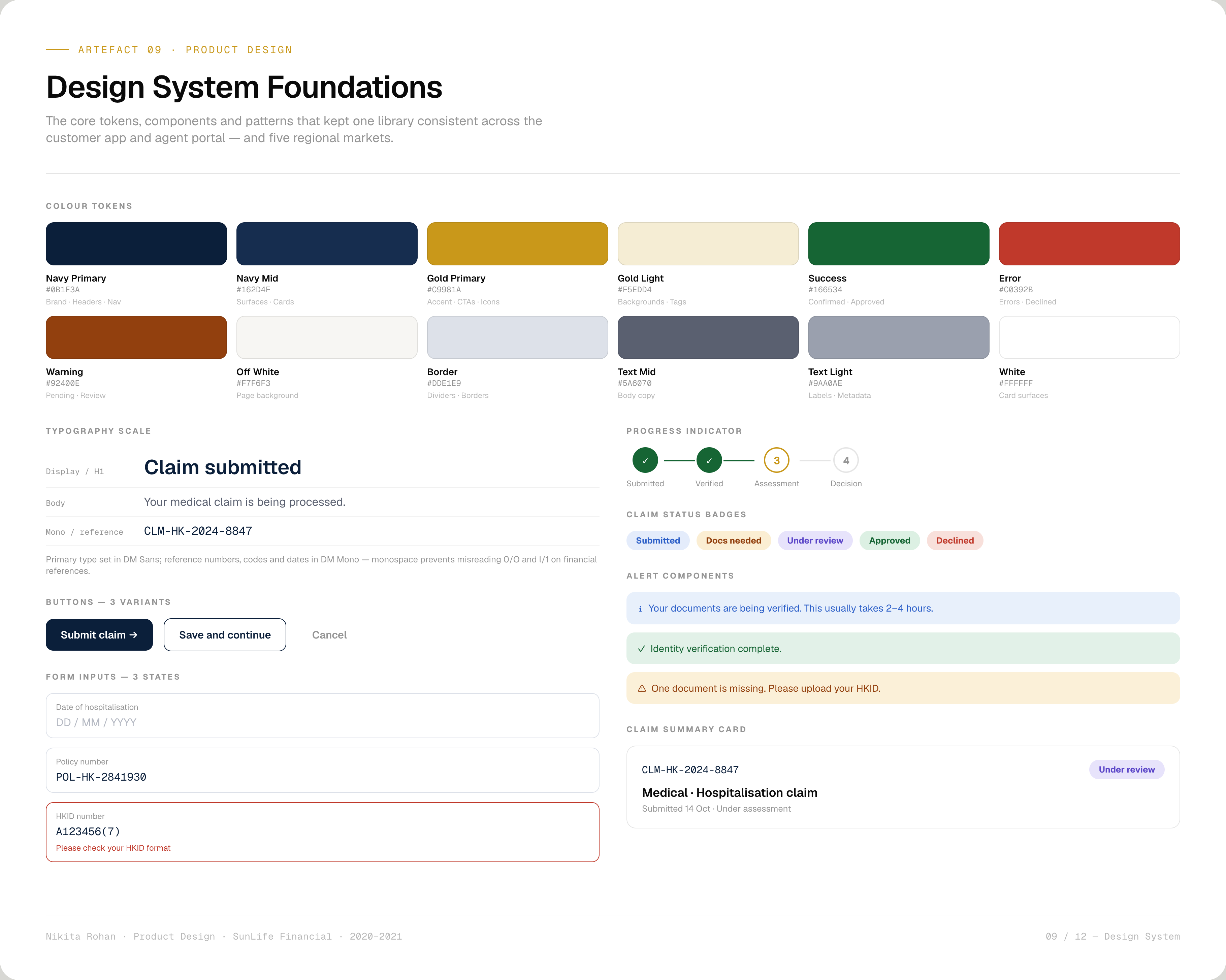
Five markets, with different regulations, document types, languages and digital maturity. One design system had to flex across all of them without fragmenting.
Inclusive & accessible design
The customer base included non-digital-native users navigating the product during high-stress life events. Every flow needed language clarity, error prevention and guided completion.
Change-management risk
Agents whose value proposition was being the intermediary. A self-service system that reduced dependency had to make agents more valuable, not redundant.
05 · Design Process
From paper to production
The claims workstream followed a structured process: grounded in operational reality, constrained by compliance, validated by the people who'd actually use it, and built iteratively alongside engineering rather than handed over as a finished spec.
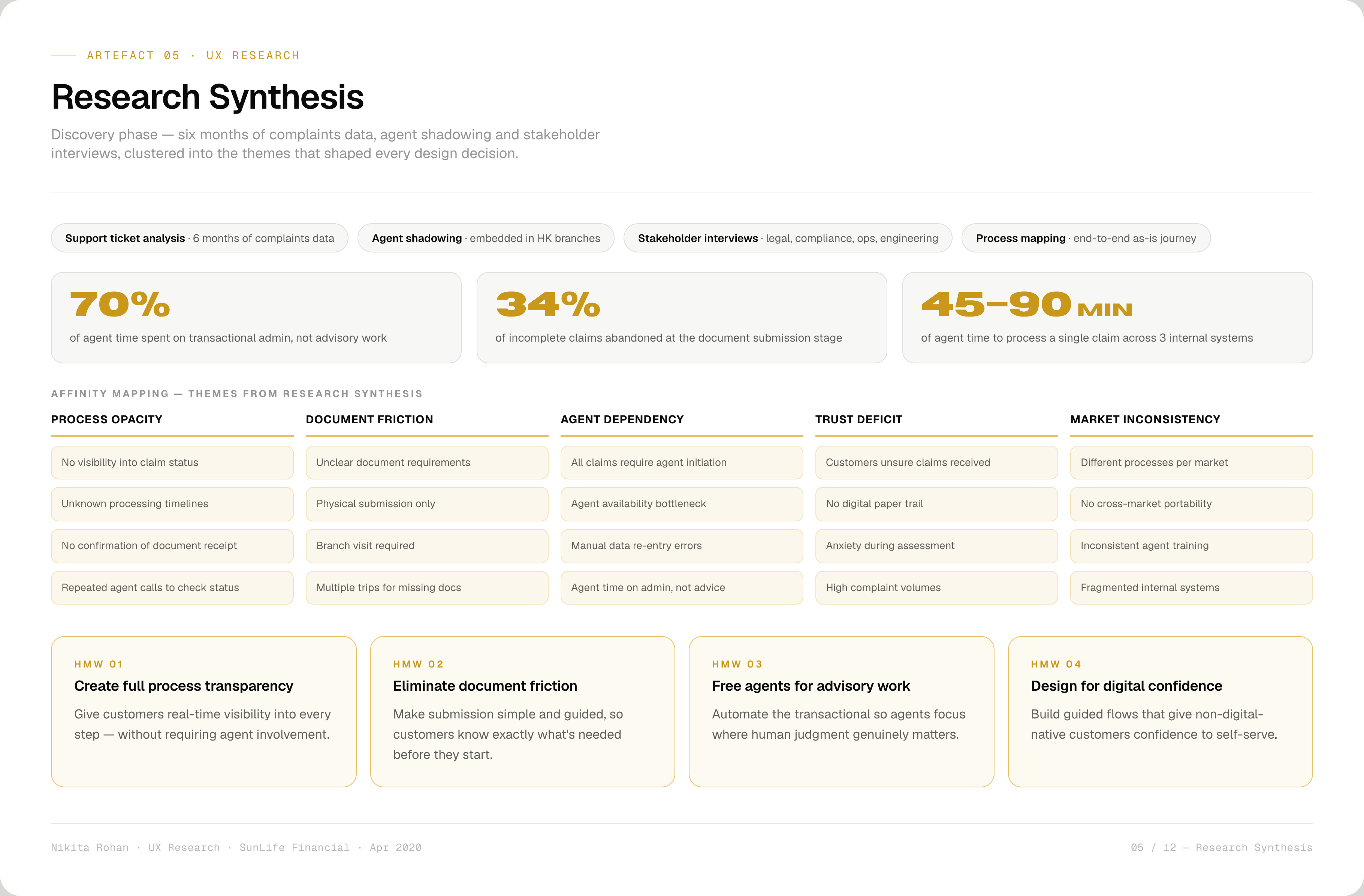
Operational discovery: understanding the real system
Before any wireframes, I immersed myself in the operational reality: reviewing support tickets and complaints data, and mapping the existing process in its entirety (customer journey, agent workflow, back-office dependencies, document flows and system touchpoints). The goal was to understand why it had been built that way, not just what was broken.
Discovery
Service blueprinting: mapping the full system
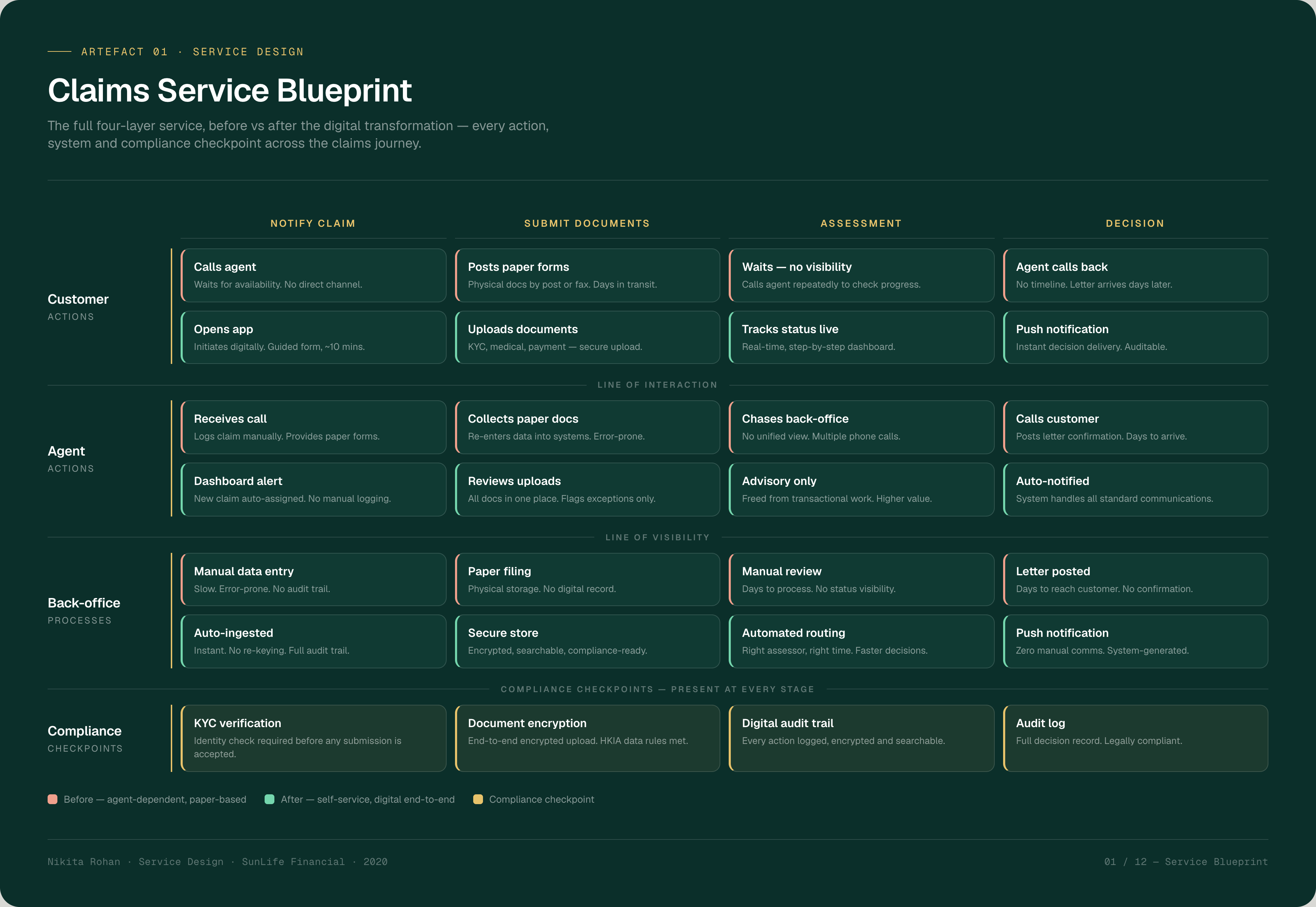
Claims aren't a single user journey. They're a multi-layered service involving customers, agents, medical assessors, back-office processors and compliance reviewers simultaneously. I blueprinted every layer, giving legal, ops, engineering and compliance a shared view of what we were building and where their constraints applied.
Service design
Flows and wireframes: designing within constraints
Wireframes developed in close collaboration with engineering and compliance simultaneously, not in sequence. Document upload, KYC verification and status-tracking interfaces went through multiple iterations as legal constraints were clarified and architecture decisions were made. Design and build were always parallel.
Product design
Sprint reviews and production handoff
Embedded in sprint ceremonies: reviews, retrospectives, planning. Screens moved to production in stages as each flow was approved and built, with design continuing on the next sprint's scope in parallel. Handoffs were iterative, not waterfall.
Delivery
Agent portal: designing for adoption, not just function
The internal counterpart to the customer-facing transformation. Agents needed a unified view of claims, policy status and action items, and, more importantly, to feel the system made them better at their jobs, not redundant. It surfaced the insights only an agent could act on while automating the transactional work.
Internal tools
The harder one
Every policyholder had an account. Almost none could get in.
Onboarding ran its own version of that process, with its own constraint claims never had to face. Every policyholder who bought a SunLife product got a mySunLife account. Almost none of them activated it. A policy sold through an advisor lived on paper and in SunLife's systems. Until the customer activated their digital account, none of it was reachable online. Activation gated everything the app offered: policies, claims, payments, documents.
Low activation wasn't a servicing inconvenience. It capped digital adoption across all five markets, kept routine servicing in call centres and branches, and left the customer relationship tied to paper and the advisor.
| Activation step | Users remaining (indicative) |
|---|---|
| App open | 100 |
| Register | ~85 |
| Verify | ~48 |
| Link | ~34 |
| First action | ~30 |
Illustrative: aggregate activation funnel across all five markets, reconstructed from the Adobe Analytics pattern. Figures indicative, not the source data.
The funnel showed where people left. It couldn't say why. Interviews (deliberately weighted toward older, less digital-confident customers, and people who'd abandoned partway) surfaced two consistent reasons: people stalled at verification out of doubt and effort, not confusion, and they couldn't recognise policies bought years earlier through an advisor. The problem was human, not just technical.
“I didn't know if it actually saved. It just asked for more and more.”
“I bought it years ago. I couldn't tell you the policy number if you asked.”
The single biggest drop-off was also the step with the least room to change. Identity verification was mandated KYC, set differently in each of the five markets, and non-negotiable with compliance. The usual playbook (strip steps out, cut fields, remove friction) was off the table. So the question changed: not “how do I remove this friction,” but “how do I get people through friction they have every reason to abandon.”
Fixed by regulation: non-negotiable, varies by market
- Identity verification (KYC)
- Document proofs
- Consent & disclosures
Ours to design
- Framing & guidance
- Progress & reassurance
- Policy recognition
- Cross-market consistency
Three decisions followed from that reframing, each working with the fixed constraint instead of against it.
Trust over speed
If verification couldn't be shortened, it could be made to feel safe and worth finishing: why each step was needed, what was required up front, and visible progress throughout, so the effort felt purposeful.
Recognition over recall
Linking failed because customers couldn't identify old policies by number. The match was redesigned around what people actually remembered: plan name, coverage, the advisor they bought from, not the reference codes the system used.
One core, many markets
Rather than five diverging flows, the shared journey was standardised and only what regulation and language required was localised, so compliance differences lived in a controlled layer instead of fragmenting the experience.
Here's where those calls became screens: conceptual wireframes, annotated to show intent rather than the shipped UI.
Verify your identity: step 2 of 3, framing the mandated KYC step instead of hiding it.
- Show progress. Step 2 of 3 and a filled bar make the effort feel finite: the antidote to an open-ended flow people abandon.
- Explain, don't hide. A “why we ask for this” note frames the mandated KYC step. It can't be removed, so it's made to feel reasonable instead.
- Set expectations. Requirements shown up front mean fewer mid-flow surprises at the step that leaks the most.
Find your policy: matching by what people recognise, not what they've forgotten.
- Recognition, not recall. Plan name, coverage and advisor: how people actually remember a policy, not a number they never kept.
- One-tap match. The customer confirms a match the system proposes, instead of recalling an identifier they don't have.
- Escape hatch. Entering a number by hand stays available for edge cases, but it isn't the route most people are forced down.
Your cover: the payoff screen, once activation is done.
- See what you own. Total cover in plain terms: the first moment activation pays off, and the reason the flow was worth finishing.
- No jargon. Holdings named by what they are and whether they're active, not by internal product codes.
- Self-serve, from here. Claims, payments and documents: tasks that used to need a call, now one tap from the home screen.
“When you can't remove friction, design people through it.”
What I can stand behind
- A coherent path through activation steps that couldn't be removed
- One shared experience maintained across five markets, not five built separately
- The verification, recognition and locale patterns folded into the Asia Design System, reused beyond this flow
What I won't claim
- Ownership of the full-funnel outcome alone: this was regional product-team work
- A single headline improvement number: where activation was measured, it was read through the same funnel that surfaced the problem
- That every screen shown here is a record of shipped UI: some is reconstructed or extended for portfolio purposes
07 · Outcomes
What moved, and why it mattered
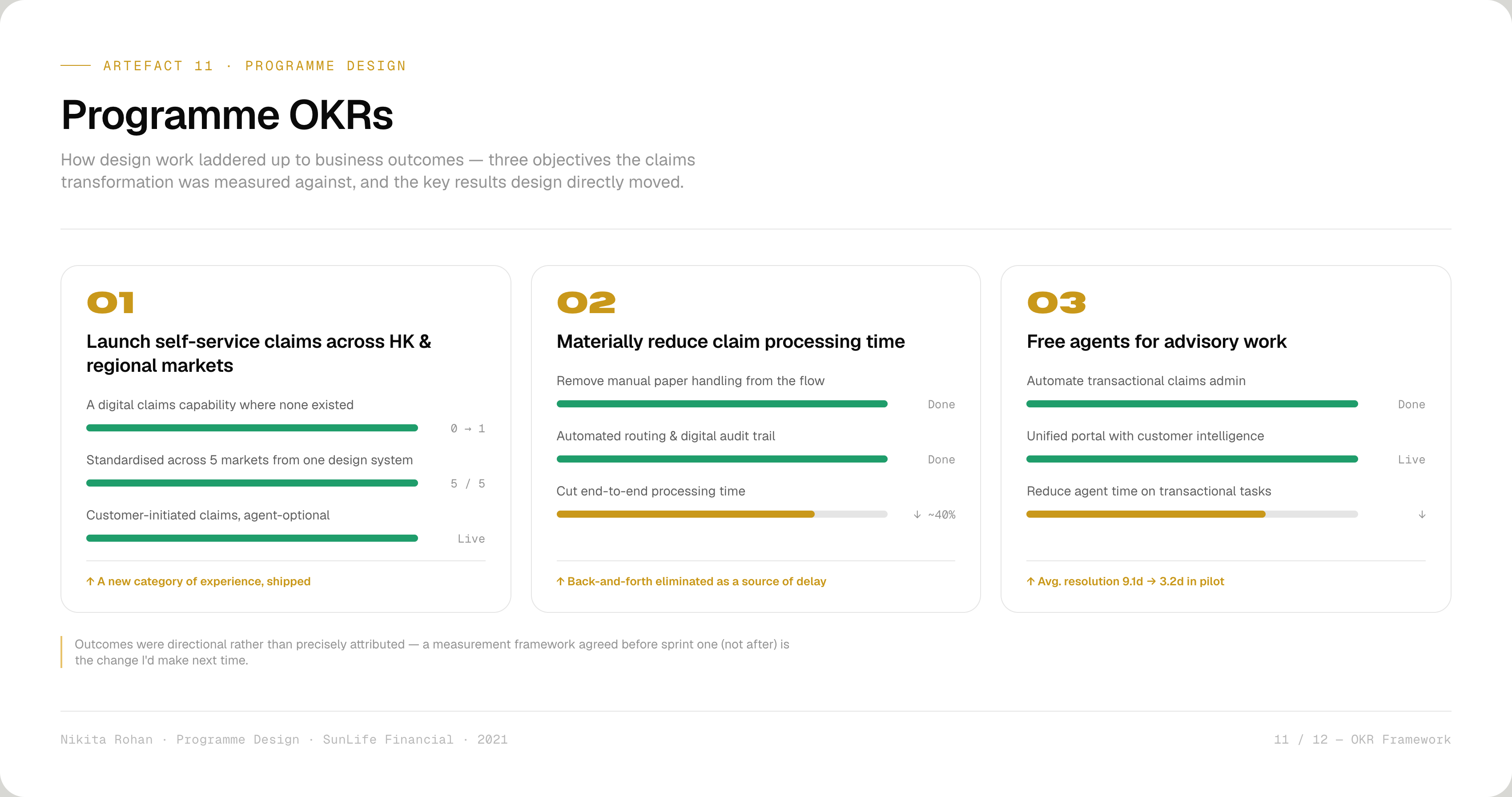
The outcomes of a 21-month enterprise transformation aren't a single metric. They're a shift in how an organisation operates. The numbers were directional rather than precisely tracked by design alone, but the direction was unambiguous.
Self-service claims: built from nothing
Customers across HK and regional markets could initiate, document, track and close a claim entirely digitally, without contacting an agent, a new category of experience, standardised across five markets from a single design system.
Materially faster approval
Removing manual paper handling and agent intermediation, plus automated routing and digital audit trails, materially reduced end-to-end processing time.
Reduced agent dependency
Agents who'd spent most of their time on transactional admin were freed for advisory work: the part of the role that genuinely needs human judgment.
Improved satisfaction
The primary driver of dissatisfaction (opacity and wait times) was directly addressed by real-time status tracking and digital submission.
Activation reframed, not just streamlined
The KYC drop-off couldn't be removed, so the flow was redesigned to carry people through it rather than around it. The verification and recognition patterns folded into the Asia Design System for reuse beyond this one flow.
08 · Reflection
What enterprise transformation actually teaches you
Eighteen months in a single enterprise transformation teaches you things shorter projects can't. The most important lesson wasn't about design. It was about the relationship between design and organisational change.
On designing for regulated environments. Every product instinct (move fast, ship and learn) had to be recalibrated. A screen that goes live before compliance approval isn't a learning opportunity. It's a legal liability. Compliance becomes a design partner when you bring them in at the wireframe stage, not the sign-off stage.
On the agent portal. In retrospect it was the most critical workstream, not the claims journey. If agents didn't trust the new system they'd find ways to work around it, and the customer experience would fragment again. I'd spend even more time on the adoption problem upfront.
On friction I wasn't allowed to remove. Activation looked like a friction problem. It was really a trust problem wearing a friction problem's clothes. The instinct every product designer reaches for (delete the step) was the one lever compliance wouldn't let me pull, and the work was better for it: designing for confidence, recognition and continuity around a fixed point, instead of around it.
On service blueprinting as a political tool. The blueprint wasn't just a design document. It was the first time legal, compliance, ops and engineering had seen the full end-to-end process in one place. That shared visibility moved decisions that had been blocked for months.
What I'd do differently. I'd push harder for a post-launch measurement framework from day one (agreed before the first sprint, not after the last) so the commercial impact could be attributed cleanly to specific design decisions.